What they are, what they aren’t and how to remove them.
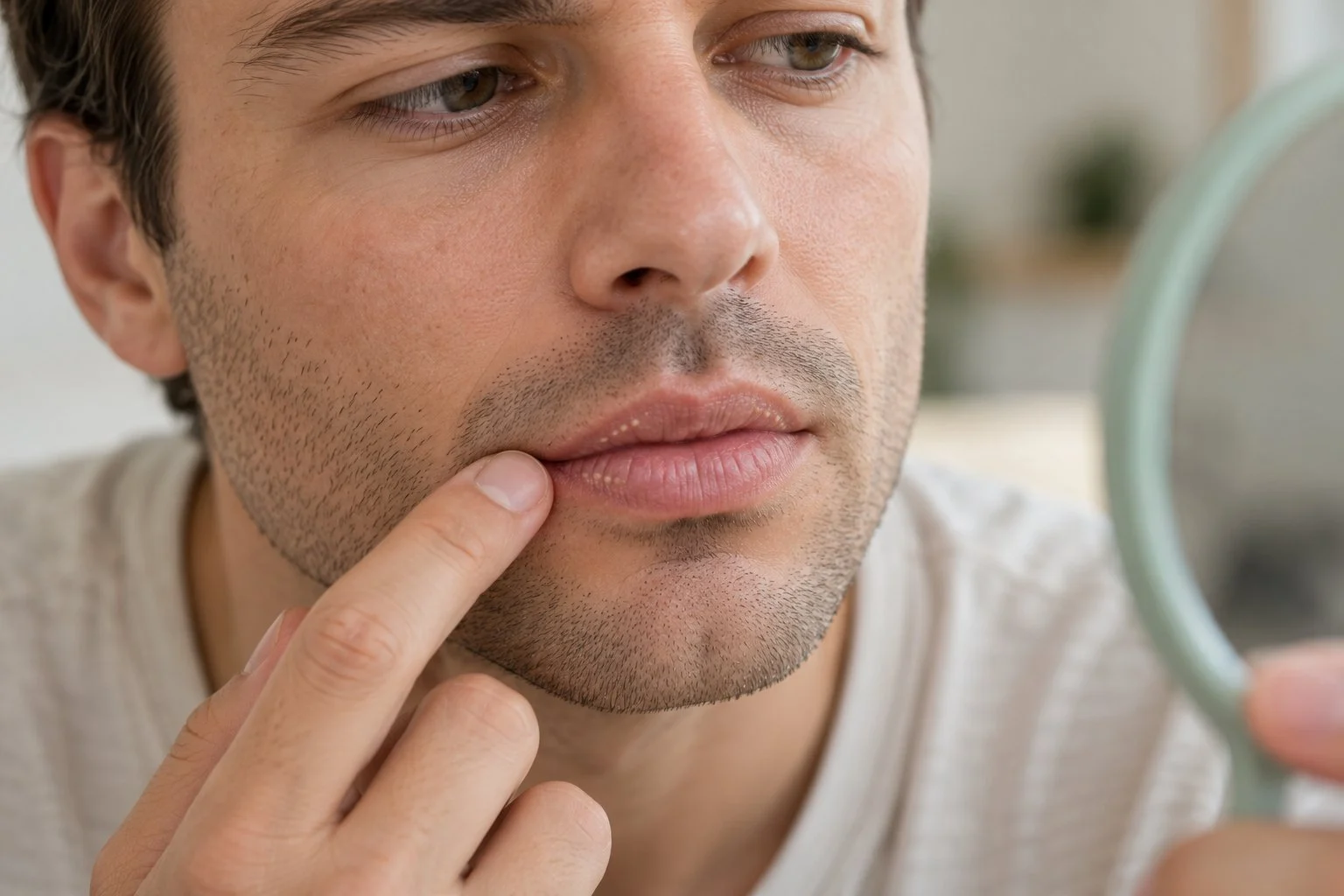
You’ve noticed small, pale or whitish-yellow spots along the border of your lips. The internet has given you a hundred worrying possibilities. Here’s the reassurance you came for: the vast majority of the time, these are Fordyce spots, and they are entirely harmless.
In this guide, our team at Eve Clinics explains what Fordyce spots on the lips are and how to tell them apart from conditions that need checking. When you’re ready, we also cover the removal options we offer and how to decide whether treatment is right for you.
Very common: seen in most adults to some degree Not contagious, no STI link CO2 laser removal available Doctor-led clinic in Leamington Spa and London. CO2 laser removal by our doctors Consultation required before treatment
In this guide
- What Are Fordyce Spots, Exactly?
- Small White Spots or Dots on Your Lips: Are They Fordyce Spots?
- Fordyce Spots vs Cold Sores vs Herpes: How to Tell Them Apart
- Will Fordyce Spots Go Away on Their Own?
- Treatment Options: What Actually Works?
- What to Expect at Eve Clinics
- Frequently Asked Questions
- Treating Patients Across Warwickshire and the Midlands
What Are Fordyce Spots, Exactly?
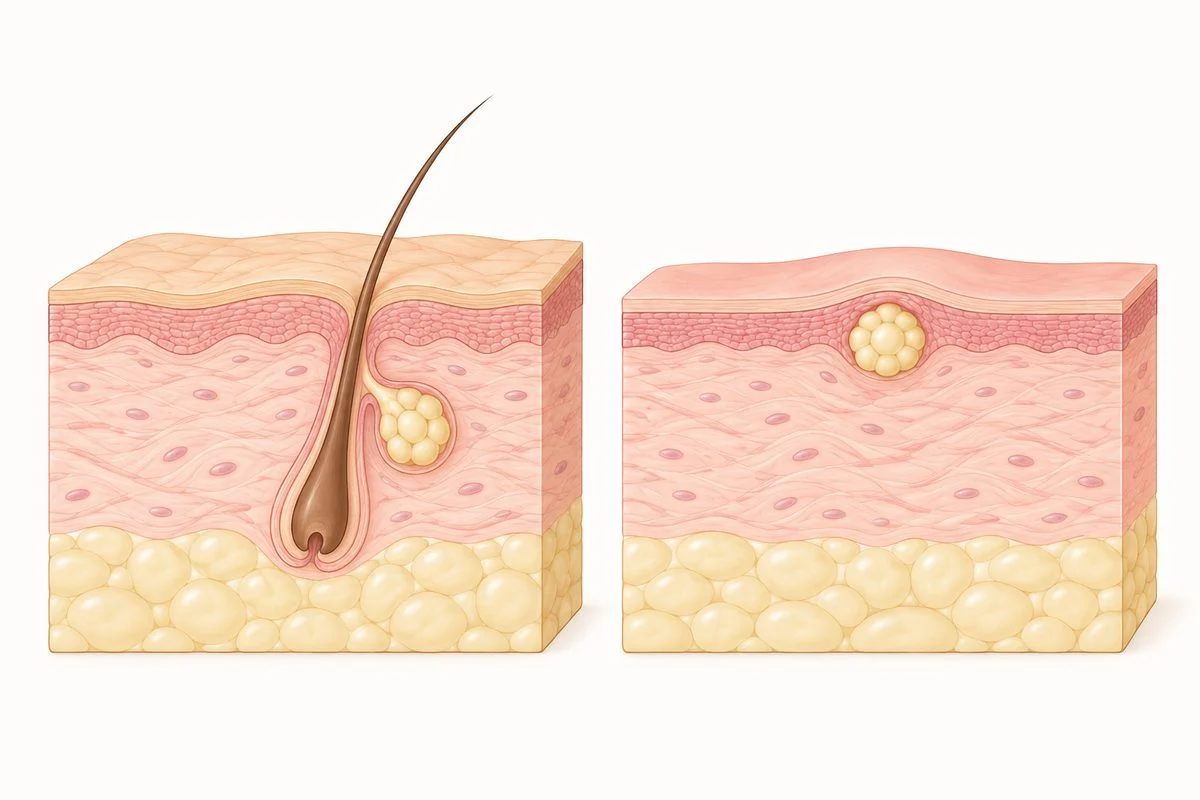
Fordyce spots are enlarged, ectopic sebaceous glands, in plain terms, they’re oil-producing glands that have appeared in a place they’re not typically supposed to be. Normally, sebaceous glands sit next to hair follicles. On the lips and around the mouth, the skin is hairless, so these glands have no follicle to sit alongside. Instead, they become visible as small, raised, pale spots just beneath the surface.
They are named after American dermatologist John Addison Fordyce, who first described them in 1896. They are not infectious, not contagious, not cancerous and not a sign of any sexually transmitted infection. They’re simply a normal anatomical variant, so common that some studies estimate they appear in up to 80–95% of adults to some degree. You are very much not alone.
What Causes Fordyce Spots on the Lips?
The vermilion border, the defined edge where your lip skin meets your facial skin, is a particularly common site. This boundary is rich in sebaceous glands that lack the usual hair-follicle anchor, making them more prone to becoming visible. Fordyce spots can also appear on the inner cheeks, the shaft of the penis, the labia and the areola.
It also helps to know what doesn’t cause them. Fordyce spots are not caused by poor hygiene, diet, lip balms, make-up or kissing; they simply reflect where your oil glands happen to sit, so there is nothing you have done to bring them on.
Fordyce Spots Inside the Lips, in the Mouth and Elsewhere
On the inner surface of the lips and the inside of the cheeks, Fordyce spots (sometimes called Fordyce granules) look like tiny pale yellow or white grains just beneath the moist lining of the mouth. They are the same harmless oil glands as those on the lip border and don’t need treatment for health reasons. Many people only notice them by chance, for example when stretching the lip in the mirror.
The same glands can also appear on the labia in women and on the shaft of the penis or the scrotum in men, where they are sometimes mistaken for genital warts. Wherever they appear, Fordyce spots are not a sexually transmitted infection. If you are unsure about a spot in the genital area, have it checked in confidence by a doctor or a sexual health clinic. You can read more about Fordyce spot treatment for men and our private female area treatments.
Can They Appear in Adulthood?
Yes, and this surprises many patients. Fordyce spots are often present from birth but microscopic. They tend to become visible during or after puberty when sebaceous glands enlarge under hormonal influence. They can also become more prominent at other times of hormonal change: pregnancy, perimenopause or periods of stress. Some patients first notice them in their 30s or 40s, not because they’re new, but because they’ve recently become visible enough to notice.
Small White Spots or Dots on Your Lips: Are They Fordyce Spots?
If you’ve noticed tiny white or yellowish dots on your lips, Fordyce spots are the most likely explanation. Signs that point towards Fordyce spots include:
- Tiny, pinhead-sized dots that are pale yellow or white
- Usually several at once, often along the edge of the upper lip or on the inside of the lips
- They are easier to see when the lip is stretched, for example when you smile
- No pain, itching or tingling, and no blistering, crusting or bleeding
- They stay much the same over weeks and months, rather than flaring up and healing
Other Causes of White Spots on the Lips
Cold sores, herpes and milia are compared with Fordyce spots in the table below. Other possible causes of white marks on or around the lips include:
- Pimples (whiteheads): acne spots along the lip line, often red and tender with a white or yellow head, that come and go rather than staying put.
- Oral thrush: creamy white patches, usually inside the mouth, that can often be wiped away to leave a red, sore area underneath.
- Sun damage (actinic cheilitis): dry, rough, scaly or pale patches, usually on the lower lip, in people who have had a lot of sun exposure over the years.
- Leukoplakia: a white patch on the lip or inside the mouth that cannot be rubbed off and does not go away.
Sun-damaged patches and white patches that don’t go away should always be checked by a doctor or dentist, as should any lip spot that bleeds, grows or changes, or a sore that doesn’t heal. This isn’t a reason to panic, but it is a reason to have them looked at in person rather than relying on photos online. If you’re unsure what you’re seeing, our specialists can examine your lips at a consultation in Leamington Spa or on Harley Street, London.
Fordyce Spots vs Cold Sores vs Herpes: How to Tell Them Apart
This is the question we receive most frequently in clinic, and understandably so. A new bump on the lip is anxiety-provoking. Here is a clear clinical comparison to help you understand what you’re looking at.
| Feature | Fordyce Spots | Cold Sores (HSV-1) | Herpes (HSV-2) | Milia |
|---|---|---|---|---|
| Appearance | Pale yellow/white, flat or slightly raised, uniform | Fluid-filled blisters that crust over | Painful blisters or ulcers | Hard white domed cysts |
| Pain / Sensation | None | Tingling, burning before outbreak | Often painful; flu-like symptoms | None |
| Contagious? | No | Yes, highly | Yes, highly | No |
| Come and go? | Persistent, do not heal or blister | Recurrent, heal in 7–10 days | Recurrent outbreaks | Persistent until treated |
| STI link? | None | Oral herpes (not typically STI-classified) | Yes | None |
| Treatable? | Yes: CO2 laser, hyfrecation | Antivirals manage outbreaks | Antivirals manage, not curative | Yes, extraction, laser |
When to See a Doctor Urgently
Please see your GP, pharmacist or a sexual health clinic promptly if your lip spots are painful or have blistered or crusted over. The same applies if they appeared quickly with tingling or burning. Please don’t try to diagnose them yourself. For persistent spots you’re unsure about, our specialists can also examine you at a consultation and advise on any further tests you may need. No question is too embarrassing to ask.
Will Fordyce Spots Go Away on Their Own?
In the vast majority of cases, no. Fordyce spots are structural, they are enlarged glands, not an infection or inflammation that the body will resolve. Some patients find they fluctuate slightly in visibility, but they do not disappear without treatment.
There is also no clinical evidence that home remedies, apple cider vinegar, tea tree oil, retinol, coconut oil or vitamin E, have any meaningful effect on Fordyce spots. Some of these can cause irritation or micro-damage to the delicate lip skin. We’d gently steer you away from DIY routes for this particular condition.
Treatment Options: What Actually Works?
When the spots are cosmetically bothersome, affecting confidence, intimacy or simply how you feel looking in the mirror, there are treatments that can reduce or remove visible spots. At Eve Clinics, we offer a specialist-led assessment before recommending any approach, view our Fordyce spot treatment page for full details. The right treatment depends on the number of spots, their size, distribution and your skin type.
CO2 Laser Removal of Fordyce Spots on the Lips
Our preferred treatment for Fordyce spots on the lips. The DEKA SmartXide CO2 laser uses a precise beam to remove the visible glands while aiming to limit heat to the surrounding skin. Suitable for multiple spots in a single session. Downtime is typically 5 to 10 days of healing. As with any laser treatment on the lips, there are risks. These include temporary redness and swelling, changes in skin colour, infection, a cold sore flare-up and, rarely, scarring or changes to the lip outline. Your specialist will discuss these in full at your consultation. Results are often long-lasting, although some spots can gradually return.
Hyfrecation (Electrosurgery)
A fine electric current is used to cauterise each gland individually. Effective for isolated, superficial spots. It may carry a risk of scarring on the delicate lip border, so we only use it in specific cases. Downtime: 3–7 days.
Can Creams Help?
Some prescription creams are occasionally discussed for Fordyce spots, but they don’t remove the glands. Your doctor or GP can advise whether anything like this is suitable for you.
Why Specialist-Led Treatment Matters for the Lips
The lips are extraordinarily delicate, the skin of the vermilion border is only a fraction of a millimetre thick in places. Treatment here demands precision, anatomical knowledge and the clinical judgement to know when not to treat. A specialist consultation is not a luxury here; it is a clinical necessity.
What to Expect at Eve Clinics
Your journey begins with a one-to-one medical consultation with one of our specialists. We’ll examine the spots, confirm the diagnosis, discuss your concerns and cosmetic goals and walk you through your realistic options honestly.
If CO2 laser treatment is right for you, we’ll apply a topical anaesthetic cream to the area before treatment begins. The laser pass itself takes between 15 and 45 minutes depending on the extent of the spots. You’ll leave with a simple aftercare protocol and direct access to our clinical team during your healing period.
We are honest about outcomes. Many patients notice an improvement after CO2 laser treatment, but results vary. In some people, Fordyce spots can gradually return over 1 to 3 years as the underlying glands regenerate. We’ll talk you through realistic expectations at your consultation.
Consultation First: Always
We do not book laser treatment without a prior medical consultation, no exceptions. During your consultation, our specialist will confirm your diagnosis, discuss your options and provide a full personalised treatment plan and quote. Contact us to arrange yours.
Frequently Asked Questions
Are Fordyce spots on lips normal?
Completely. Research suggests most adults have some degree of Fordyce spots, most commonly on the vermilion border of the lips. They are a normal anatomical variant, not a disease, not a sign of illness and not something you should feel embarrassed about.
Can Fordyce spots on lips be a sign of herpes or an STI?
No. Fordyce spots have no connection to herpes, HPV or any sexually transmitted infection. They are enlarged sebaceous glands, entirely benign, non-infectious structures. The key differences: Fordyce spots are painless, persistent, do not blister, do not crust and do not come and go. If you have any doubt, book a consultation so a specialist can examine you in person.
Why have my Fordyce spots appeared or worsened in adulthood?
Fordyce spots are often present microscopically from a young age but enlarge and become visible during or after puberty, driven by sebaceous gland activity under hormonal influence. They can also become more noticeable during pregnancy, perimenopause or other hormonal shifts. Some patients only notice them for the first time in their 30s or 40s, they’ve simply become visible for the first time.
Do home remedies like apple cider vinegar or tea tree oil work?
There is no clinical evidence that any topical home remedy meaningfully removes Fordyce spots. These are structural glands beneath the skin surface; topical products cannot penetrate deeply enough to ablate them. Some remedies can irritate or damage the delicate lip skin.
How long is recovery after CO2 laser treatment on the lips?
Most patients experience 5–10 days of healing. In the first 2–3 days the area will be pink, mildly swollen and tender. By day 5–7 most of the surface healing is complete. We advise avoiding lip products during the active healing phase. A detailed aftercare plan is provided after your consultation.
Will the Fordyce spots come back after laser?
Many patients have long-lasting results from CO2 laser, but results vary. However, because the underlying tendency for sebaceous gland activity remains, some patients see a gradual partial return over 1–3 years. If spots return, a further treatment session can be discussed. Your specialist will advise on what’s needed.
Where in the Midlands can I get Fordyce spots on lips treated?
Eve Clinics offers Fordyce spot treatment at our Leamington Spa clinic, serving patients from across Warwickshire, Coventry, Kenilworth, Warwick, Solihull, Birmingham, Stratford-upon-Avon and beyond. We also see patients at our London Harley Street location. Remote video consultations are available. You can also read more about Fordyce spot removal at our London clinic.
Can I squeeze or pop Fordyce spots on my lips?
We’d advise against it. Fordyce spots are oil (sebaceous) glands rather than blocked pores or pimples, so there is nothing to squeeze out that will make them go away. Picking or squeezing can irritate the delicate lip skin, cause bleeding or infection and may leave a scar. If the spots bother you, one of our specialists can examine them and talk you through suitable treatment options at a consultation.
Treating Patients Across Warwickshire and the Midlands
Eve Clinics is a specialist medical aesthetics clinic based in Leamington Spa, at the heart of Warwickshire. Our patients travel from Coventry, Warwick, Kenilworth, Stratford-upon-Avon, Solihull, Birmingham and across the Midlands, as well as from London, the rest of the UK and internationally for our specialist-led treatments.
We are easily accessible from the M40 and M42 corridors, with parking available at our Leamington Spa location. Remote video consultations are available for patients further afield.
Ready to Book a Consultation?Speak with one of our specialists about Fordyce spot removal. Same-week appointments are often available in Leamington Spa and Harley Street.
References
- Fordyce JA. A peculiar affection of the mucous membrane of the lips and oral cavity. Journal of Cutaneous and Genito-Urinary Diseases. 1896;14:413–419.
- Ahuja V, Ahuja A. Fordyce spots: What a pediatric dentist needs to know? Journal of Dental Panacea. 2022;4(4):149–150. doi:10.18231/j.jdp.2022.031
- Lee JH, et al. Clinicopathologic Manifestations of Patients with Fordyce’s Spots. Annals of Dermatology. 2012;24(1):103–106. doi:10.5021/ad.2012.24.1.103. PMC3283840
- Hoover E, Aslam S, Krishnamurthy K. Physiology, Sebaceous Glands. In: StatPearls. Treasure Island (FL): StatPearls Publishing; 2024. PMID: 30726003
- Bapat PM, et al. Ectopic Sebaceous Glands over Buccal Mucosa: A Case Report on Fordyce Spot. International Journal of Head and Neck Surgery. 2021;12(3):119–120.
- Olivier A. Fordyce granules on the prolabial and oral mucous membranes of a selected population. SADJ. 2006. PubMed PMID: 16711559
- Scully C. Oral and Maxillofacial Medicine. 3rd ed. Churchill Livingstone; 2013. Chapter on Fordyce spots.
This article is written for informational purposes and does not constitute medical advice. Always consult a qualified clinician before undertaking any medical treatment.