
By the age of 50, around half of all men are affected by hair loss to some degree. Most put up with it. Some try minoxidil or finasteride with limited success. A smaller number look into what the science actually offers now and find that it has moved on considerably. E50 exosome therapy is part of that shift. Available at Eve Clinics in Leamington Spa, it is one of the most advanced regenerative options for hair loss — for men and women — that we have seen in this space.
This page explains what the treatment is, how it works, who it suits and what realistic results look like. If you are losing hair and want a straight answer to whether this is worth considering, this is it.
Treatment Areas
Treatment Benefits
What Is E50 Exosome Therapy?
E50 is a specialist exosome product manufactured by PrimaCure using a process called ENTR technology. Exosomes are nano-sized particles that cells use to communicate with each other. They carry growth factors, proteins and genetic signals that influence how surrounding cells behave.
In the context of hair loss, exosomes are of particular interest because they can deliver specific regenerative signals directly to the dermal papilla cells at the base of the hair follicle. These are the cells that control whether a hair follicle is in an active growth phase or a resting one. By delivering a concentrated dose of the right signals, the aim is to shift dormant follicles back toward active growth and improve the quality of hair produced by follicles that are still functioning but declining.
E50 exosomes are derived from salmon fibroblast cells. Human-derived exosomes are banned in the UK. Salmon-derived exosomes are approved for cosmetic use and offer a well-tolerated option with substantially reduced cross-contamination risks compared to other biological products.
Why Hair Is Lost in the First Place
Male pattern hair loss, or androgenetic alopecia, is not simply a case of hair falling out. It is a process of gradual follicle miniaturisation driven by a hormone called dihydrotestosterone, or DHT.
DHT shortens the active growth phase of the hair cycle and extends the resting phase. Over time, each follicle produces finer, shorter and less pigmented hair until it stops producing visible hair altogether. The critical point is that miniaturised follicles are not dead. They are dormant. The follicle structure remains beneath the scalp, which is why regenerative treatments that can reactivate those follicles have genuine potential.
The earlier treatment begins, the better the result. Once a follicle has fully atrophied and the hair-producing structures have been replaced by fibrous tissue, there is nothing to reactivate. Treating while follicles are dormant rather than lost produces consistently better outcomes.
[callout] The Sooner You Start, the Better the Result This is not a sales line. It is the biology. If you have noticed thinning or a receding hairline, a consultation now is more valuable than waiting six months to see whether it gets worse. [/callout]
Where You Sit on the Norwood Scale
The Norwood-Hamilton scale is the standard classification for male pattern hair loss, running from Type I (no significant loss) to Type VII (only a band of hair remaining around the sides and back). Where you sit on this scale matters for treatment decisions.
| Norwood Type | What It Looks Like | E50 Suitability |
|---|---|---|
| Type I | No significant recession. Hairline largely intact. | Prevention. A good time to start with a strong family history. |
| Type II | Minor recession at the temples. Early hairline changes. | Very good candidate. Follicles healthy and responsive. |
| Type III | Deeper temporal recession. Possible early crown thinning. | Good candidate. Ideal window for treatment. |
| Type IV | Significant recession and crown thinning beginning to develop. | Good candidate. Treatment can slow progression and improve density. |
| Type V | Larger bald areas beginning to merge. Strip between them thinning. | Moderate candidate. Results vary. Assessment required. |
| Type VI | Crown and temple areas merged. Only side and back hair remaining. | Limited benefit. Follicles in fully bald areas likely atrophied. |
| Type VII | Only a narrow band of hair around the sides and back. | Not suitable. Follicle loss in affected areas largely permanent. |
How E50 Works on the Hair Follicle
E50 exosomes carry a specific cargo of growth factors and signalling molecules that interact with the biology of the hair follicle in several ways.
Treatment Benefits
- Dermal papilla stimulation — the cells at the base of each follicle that regulate the hair growth cycle are stimulated to become more active and to proliferate
- Stem cell activation — the bulge region of the follicle contains hair follicle stem cells responsible for initiating each new growth cycle. E50 promotes their activation
- Anagen phase extension — the active growth phase of the hair cycle is extended and the resting phase shortened, directly counteracting one of the core mechanisms of hair loss
- DHT mitigation — exosomes derived from adipose stem cells have been shown to partially mitigate the damaging effect of DHT on hair follicles, helping to slow the miniaturisation process
- Anti-inflammatory action — perifollicular inflammation is a secondary contributor to hair loss in many patients. E50 carries anti-inflammatory signalling molecules that reduce this and improve the follicular environment
- Improved blood supply — better blood vessel formation around the follicle bed increases oxygen and nutrient delivery to the hair roots, supporting sustained growth over time
What Happens During Treatment
The scalp is cleansed and a microneedling device is passed over the treatment area, creating fine channels in the skin. The E50 solution is then applied and worked into the scalp, where it is absorbed through these micro-channels to reach the dermal papilla layer.
Most patients describe a mild tingling or pressure sensation during the microneedling phase. There is typically no significant downtime. The scalp may appear slightly red for 12 to 24 hours and most patients return to work the same day.
How Many Sessions Are Needed
The standard course at Eve Clinics is five sessions. The first two are spaced two to four weeks apart, followed by three monthly sessions to complete the course. After that, a maintenance schedule of two sessions per year is recommended to sustain the results.
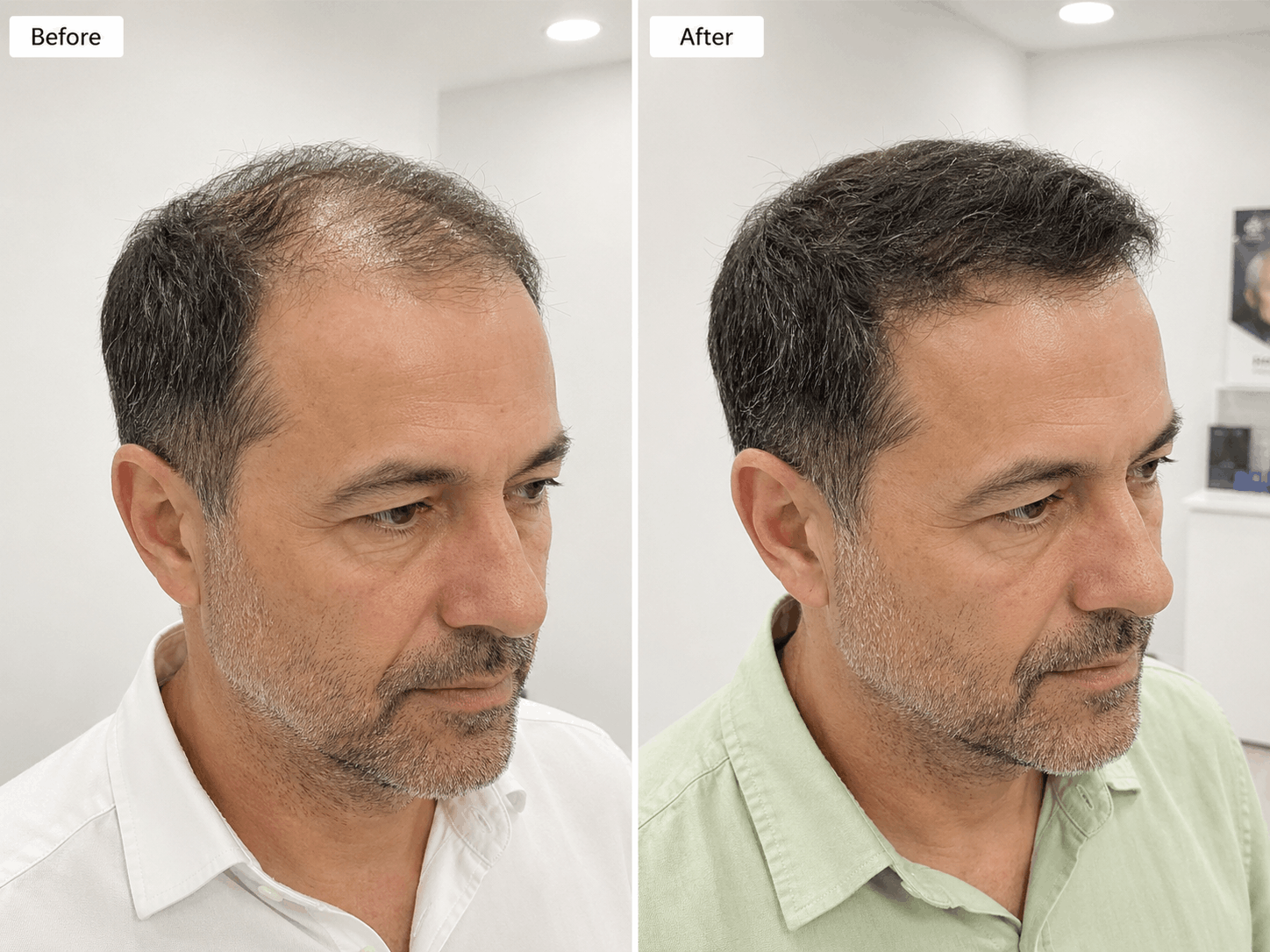
Results develop gradually. Most patients notice a reduction in shedding within the first few sessions. Visible improvements in density and hair quality typically become apparent two to four months into the course and continue developing for up to six months after the final session.
How E50 Compares to Other Options
| Treatment | How It Works | Evidence | Downtime | Ongoing Commitment |
|---|---|---|---|---|
| E50 Exosomes | Growth factor signals to dormant follicles. Extends anagen phase. Reduces inflammation. | Emerging. Promising RCT and cohort data. Systematic reviews favourable. | Minimal. 12 to 24 hours mild redness. | Initial course of 5 sessions, then twice yearly maintenance. |
| Minoxidil (topical) | Vasodilator that increases blood flow to follicles. | Strong. Decades of RCT evidence. MHRA licensed. | None. | Daily application indefinitely. Hair loss resumes on stopping. |
| Finasteride (oral) | Reduces DHT levels in the scalp by inhibiting 5-alpha reductase. | Strong. MHRA licensed for men. Prescription required. | None. | Daily tablet indefinitely. Possible sexual side effects in some men. |
| PRP | Concentrates growth factors from the patient’s own blood and injects into the scalp. | Moderate. Good cohort data. No licensed product. | Minimal. Mild tenderness for 24 to 48 hours. | Initial course then maintenance every 6 to 12 months. |
| Hair Transplant | Surgical relocation of DHT-resistant follicles from the back and sides of the scalp. | Strong for appropriate candidates. | Significant. 7 to 14 days surgical recovery. | Transplanted hair is permanent but donor area is finite. Medical treatment often needed alongside. |
[callout-dark] Honest Expectations E50 exosome therapy can slow hair loss progression, improve density and quality of hair in thinning areas and, in good candidates, promote visible regrowth. It is not a cure for androgenetic alopecia. The underlying genetic sensitivity to DHT remains. Without maintenance treatment, progression will eventually resume. Results vary between individuals and we will give you a realistic assessment of what is achievable for your specific pattern at consultation. [/callout-dark]
Who Is a Good Candidate
E50 is most effective in patients with early to moderate androgenetic alopecia, typically at Norwood stages II to V, where there are still active or recently miniaturised follicles in the thinning areas. It is also a sensible preventative measure for those at Norwood I or II with a strong family history of significant hair loss.
Patients who are unlikely to benefit significantly are those at Norwood VI or VII where affected areas are largely or completely bald, and those who have had hair loss for more than twenty years in the affected areas.
E50 also works well alongside other treatments. For patients already using minoxidil or finasteride with partial results, E50 addresses the regenerative component that medication alone cannot. For those who have had or are planning a hair transplant, E50 supports graft survival and follicle activation in both transplanted and surrounding areas.
The Evidence
We are transparent about where the evidence stands. Exosome therapy for hair loss is a genuinely emerging field. The early clinical results are promising but the evidence base is still developing and we would not claim otherwise.
A 2025 randomised controlled trial published in the journal Life evaluated an exosome-containing formulation in 20 male participants with Norwood Grade 2 to 3 hair loss. The exosome group showed significantly higher hair count improvement compared to the placebo group, with no adverse effects reported. A 2025 systematic review published in Cureus comparing exosome therapy, PRP and minoxidil concluded that exosome therapy demonstrated the most promising results for hair regrowth and safety of the three modalities reviewed.
We recommend E50 as part of a broader hair loss management plan, not as a standalone replacement for established medical treatments where those are appropriate.
Why Choose Eve Clinics for Hair Loss Treatment in Leamington Spa
Eve Clinics is based in Leamington Spa, Warwickshire. We see patients from Coventry, Birmingham, Solihull, Warwick, Kenilworth, Stratford-upon-Avon and across the wider Midlands. Our London Harley Street clinic serves patients based in the capital.
Hair loss affects confidence in a way that is often difficult to discuss. We treat it with the same clinical seriousness as any other medical aesthetic concern. A consultation starts with a proper assessment of your hair loss pattern, its stage and its likely trajectory, followed by an honest conversation about what E50 can and cannot achieve for you specifically.
Treatment Benefits
- Treatment by an experienced specialist or doctor
- Personalised treatment planning based on your hair loss pattern and stage
- E50 exosome therapy using approved salmon-derived exosomes
- Compatible with existing hair loss medication
- Consultation before any treatment is recommended
- Same-week appointments available in Leamington Spa
See our price list for treatment costs or check our current special offers.
Frequently Asked Questions
The standard initial course is five sessions. The first two are spaced two to four weeks apart and the remaining three are monthly. Maintenance treatment twice a year is recommended after the initial course to sustain the improvement and slow ongoing hair loss.
No. Exosome therapy stimulates biological processes that unfold over weeks and months. Most patients notice reduced shedding within the first few sessions, which is usually the first sign the treatment is working. Visible improvements in density typically become apparent two to four months into the course and continue developing for up to six months after the final session.
In most cases, no. E50 works by reactivating miniaturised follicles. Once a follicle has fully atrophied and been replaced by fibrous tissue there is nothing to reactivate. The treatment is most effective in thinning areas where follicles are still present but performing poorly. This is assessed thoroughly at consultation.
Yes. E50 is entirely compatible with both topical minoxidil and oral finasteride. They work through different pathways and complement each other well. Minoxidil and finasteride address the hormonal mechanism of hair loss while E50 addresses the regenerative component. We will discuss your current regimen at consultation and factor it into the treatment plan.
Most patients find it comfortable. The microneedling phase produces a mild tingling or pressure sensation on the scalp, which most patients describe as tolerable without anaesthetic. Topical numbing can be applied beforehand for those who are sensitive. The scalp may feel slightly tender and appear pink for 12 to 24 hours. There is no significant downtime.
E50 is derived from salmon cells and approved for cosmetic use in the UK. The salmon-derived source substantially reduces the cross-contamination risks associated with other biological products. No significant adverse effects have been reported in clinical studies. A full medical history review is conducted before treatment begins.
Yes. While male pattern hair loss is the most common presentation we treat, E50 exosome therapy is also used for female pattern hair loss and other forms of hair thinning. Suitability is assessed at consultation for every patient.
Eve Clinics offers E50 exosome hair treatment at our Leamington Spa clinic, serving patients from across Warwickshire, Coventry, Kenilworth, Warwick, Solihull, Birmingham and Stratford-upon-Avon.