
Cosmelan Peel for Pigmentation and Melasma
Pigmentation is one of the most frustrating skin concerns to treat. It resists most standard treatments, returns with sun exposure and, in the case of melasma, can worsen with the wrong approach. If you have been managing your pigmentation with creams, peels or laser treatments with limited success, the Cosmelan peel may be the intervention that finally moves the dial.
At Eve Clinics, the Cosmelan depigmentation treatment is performed by Dr Matt George, our Plastic Surgery trained cosmetic doctor with a Level 7 Aesthetics Diploma. In this guide he explains what Cosmelan is, how it works, what types of pigmentation it treats and what you can realistically expect from the process.
What Is the Cosmelan Peel?
Cosmelan is a professional-grade depigmentation system developed by Mesoestetic, one of the world's leading medical aesthetic laboratories. It is widely regarded as the most effective non-laser treatment available for hyperpigmentation and is particularly notable for being one of the only treatments proven effective across all skin tones, including the darker Fitzpatrick types that are often excluded from or at risk from other pigmentation treatments.
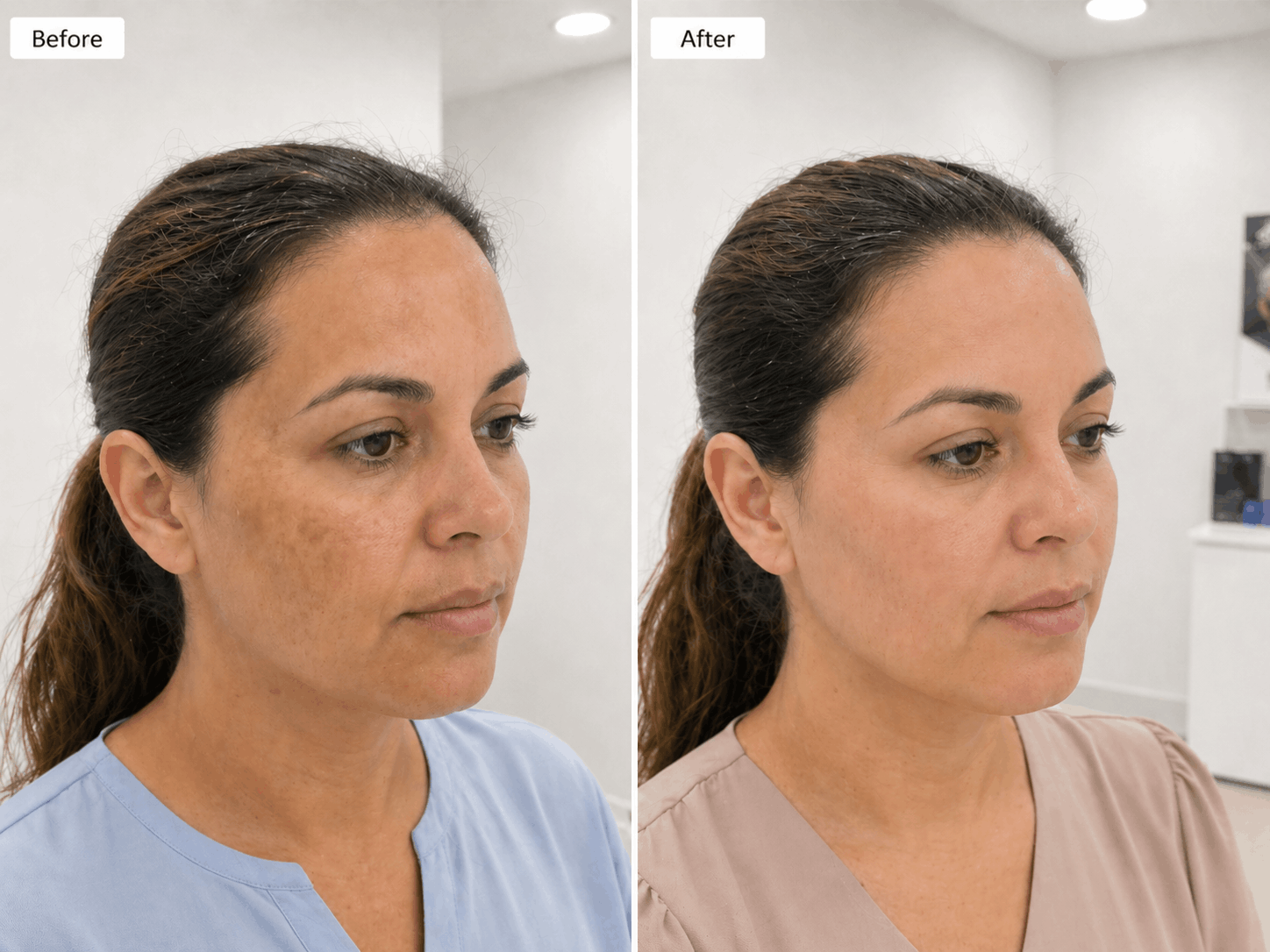
Unlike a standard chemical peel, which works primarily by removing the outer layers of skin, Cosmelan operates at two levels simultaneously. It delivers an immediate corrective effect by exfoliating the surface and visibly reducing existing pigmentation. At the same time, it works at the cellular level to regulate the melanin production process, reducing the likelihood of the pigmentation returning.
This dual action is what sets Cosmelan apart from most other approaches to pigmentation. Standard peels and even laser treatments can lighten existing dark marks effectively, but they do not address the underlying melanocyte overactivity that caused those marks in the first place. Without that regulatory component, pigmentation typically returns, often quickly. Cosmelan's at-home maintenance phase targets this problem directly over a period of months, training the melanocytes to produce pigment in a more regulated and uniform way.
What Types of Pigmentation Does Cosmelan Treat?
Cosmelan is suitable for all types of hyperpigmentation, including some of the most treatment-resistant forms. It is manufactured without hydroquinone, making it a safe choice for patients who prefer to avoid that ingredient or who have had sensitivities to it in other products.
| Pigmentation Type | What It Is | Common Triggers | Cosmelan Suitability |
|---|---|---|---|
| Melasma | Brown or grey-brown patches, typically on the cheeks, forehead and upper lip. Often symmetrical. | Hormonal changes: pregnancy, the contraceptive pill, HRT, perimenopause | Excellent. Cosmelan is one of the most effective treatments for melasma, including hormone-induced cases resistant to other treatments. |
| Chloasma | The pregnancy-specific form of melasma. Sometimes called the "mask of pregnancy." | Hormonal changes during pregnancy | Excellent. Treatment is deferred until after delivery and breastfeeding has ended. |
| Post-inflammatory hyperpigmentation (PIH) | Dark marks left after skin inflammation. Common after acne, injury or certain treatments. | Acne, eczema, burns, chemical peels, laser procedures, waxing | Excellent. Particularly effective for darker skin tones where PIH is more pronounced and persistent. |
| Solar lentigos (sun spots) | Flat, well-defined brown spots caused by cumulative UV exposure. Also called age spots or liver spots. | Years of UV exposure, typically on face, hands and décolletage | Very good. Cosmelan visibly reduces and regulates sun-related pigmentation. |
| Ephelides (freckles) | Small, flat, light brown spots typically on fairer skin. More visible in summer. | Genetic predisposition, UV exposure | Good. Cosmelan can significantly reduce freckle intensity, particularly with consistent maintenance. |
| Diffuse uneven skin tone | General lack of uniformity in skin colour without distinct spots. Often described as dullness or blotchiness. | Sun damage, ageing, lifestyle factors | Good. Cosmelan improves overall luminosity and skin tone evenness alongside targeted pigmentation. |
A Note on Melasma Specifically
Melasma deserves particular mention because it is both the most common reason patients seek the Cosmelan peel and the most treatment-resistant form of pigmentation. Melasma is driven by melanocyte hyperactivity, the cells that produce pigment become overactive and produce far more melanin than is needed in certain areas of the face. This overactivity is often triggered and maintained by hormonal factors, UV exposure or heat. Simply removing the surface pigment without addressing the underlying cellular behaviour means the marks will return within weeks or months of treatment.
Melasma also has a reputation for being worsened by aggressive laser treatments and incorrect chemical peels, particularly in patients with darker skin tones. The inflammatory response triggered by these treatments can actually stimulate further melanin production, making the condition worse rather than better. Cosmelan's formulation is specifically designed to regulate rather than aggressively ablate, which is why it produces reliable results in melasma patients where other approaches have failed or caused damage.
Melasma is a chronic condition, not a fixed mark. The melanocytes responsible for it remain hyperactive until they are regulated. Without a treatment that addresses this regulatory component, pigmentation will return, often within months. This is why the at-home maintenance phase of Cosmelan is not optional. The in-clinic mask removes the existing pigmentation. The Cosmelan 2 cream, used consistently at home for months afterwards, retrains the melanocytes. Both phases are essential for lasting results.
How Does Cosmelan Work? The Science Explained Clearly
The fundamental driver of hyperpigmentation is an enzyme called tyrosinase. Tyrosinase is responsible for the initial step in melanin production. When melanocytes (the pigment-producing cells) are stimulated, by UV exposure, hormones, heat or inflammation, they increase their tyrosinase activity, which leads to the overproduction of melanin and the formation of dark marks.
Cosmelan works primarily by inhibiting tyrosinase activity. When the production of this enzyme is suppressed, the melanocytes cannot overproduce melanin in the same way, regardless of the external stimulus. Over time, with consistent application of the maintenance products, the melanocyte behaviour is normalised and the tendency to produce excess pigment is significantly reduced.
The active ingredient complex in Cosmelan works across multiple pathways simultaneously:
- Azelaic acid: inhibits tyrosinase and reduces melanocyte proliferation. Also provides anti-inflammatory benefit, which is particularly important in inflammatory pigmentation types.
- Kojic acid: a powerful tyrosinase inhibitor derived from fungal fermentation. Widely studied and clinically proven for depigmentation.
- Phytic acid: inhibits melanin synthesis and provides antioxidant protection, reducing oxidative triggers of melanocyte activation.
- Ascorbic acid (vitamin C): interferes with melanin formation at multiple stages and provides broad antioxidant protection against UV-induced melanin production.
- Retinoids: accelerate cell turnover to speed the removal of pigmented cells from the surface and enhance penetration of the other active ingredients.
- Arbutin: a naturally derived tyrosinase inhibitor with a gentle safety profile, particularly useful in sensitive skin types.
This multi-ingredient approach means Cosmelan acts on melanin production at several points in the process simultaneously, rather than targeting a single pathway. The redundancy of mechanism is one of the reasons it achieves results where single-ingredient treatments have not.
The Cosmelan Treatment Process: What to Expect
Understanding what the process involves before you start makes the recovery period significantly more manageable. Cosmelan is not a treatment you can have on a Friday and appear at work on Monday looking refreshed. It requires a week of genuine social downtime and a committed at-home maintenance routine lasting several months. The results, for patients who follow the protocol properly, are outstanding. But the protocol must be followed.
Step 1: Consultation and Skin Assessment
Your treatment begins with a thorough consultation with Dr Matt George. He will assess the type, depth and distribution of your pigmentation, determine your Fitzpatrick skin type, review your medical history and any medications you are taking and confirm that Cosmelan is the appropriate approach for you. If you are on hormonal contraception, HRT or other medications that may affect melanin production, this is discussed at consultation and factors into the treatment plan.
Certain preparations are required before the in-clinic mask. You must stop using retinoids and glycolic acid products for one week beforehand and must not have had waxing or depilatory treatments on the face within two weeks of treatment.
Step 2: In-Clinic Mask Application
The skin is cleansed and a degreasing solution is applied to improve ingredient penetration. Dr George then applies the Cosmelan 1 mask, a concentrated paste containing the full active ingredient complex at its highest concentration. The mask is left to dry on the skin in clinic and you are sent home wearing it.
The mask must remain on the skin for between 8 and 12 hours depending on your Fitzpatrick type, skin sensitivity and the severity of your pigmentation. Dr George will give you a precise removal time based on your individual assessment. The mask is removed at home using warm water only, no cleanser at this stage.
Step 3: The Recovery Week
The days following the mask removal are the most intensive part of the process. Most patients experience significant redness, warmth and tightness in the first 24 hours, similar to moderate sunburn. From days two to five, the skin will begin to peel, sometimes dramatically. This peeling is the old, pigmented surface skin being shed and new, fresh skin being revealed underneath. The itching that accompanies this phase is a sign that the skin is actively regenerating.
During this phase it is essential not to pick or pull the peeling skin, as this risks post-inflammatory pigmentation forming in the areas of disrupted tissue. The prescribed soothing balm and SPF should be applied consistently throughout the day.
Most patients are not socially presentable during the first five to seven days after treatment. Plan accordingly. Do not schedule this treatment close to important social events, professional occasions or holidays.
Step 4: At-Home Maintenance with Cosmelan 2
Seven days after removing the mask, the Cosmelan 2 maintenance cream is introduced. This is the regulatory phase of the treatment and it is not optional. Cosmelan 2 contains the same tyrosinase-inhibiting ingredients at lower concentrations, designed for daily use. It continues to suppress melanocyte overactivity and prevent the return of pigmentation while the skin completes its remodelling.
The application schedule for Cosmelan 2 is intensive at first: three times daily in the first month, twice daily in the second and third months, once daily in the evening from month four onwards. This commitment is what separates patients who maintain their results long-term from those who see the pigmentation return within months.
SPF 50 must be worn every morning without exception throughout the maintenance phase and beyond. UV exposure is the primary trigger for melanocyte overactivity. Treating pigmentation and then allowing unprotected sun exposure is the single most common reason results are not maintained.
Recovery Timeline: Day by Day
| Timeframe | What to Expect | What to Do |
|---|---|---|
| Mask on (8 to 12 hours) | Skin feels warm and tight. Mild tingling normal. | Avoid touching the mask. Keep to scheduled removal time given by Dr George. |
| Day 1 (removal day) | Significant redness, warmth and tightness. Skin may look bronzed or flushed. | Remove with warm water only. Apply prescribed recovery balm generously. Avoid heat. |
| Days 2 to 5 | Skin begins to peel, sometimes extensively. Itching common. Not socially presentable for most patients. | Do not pick or pull peeling skin. Apply balm frequently. Wear SPF if going outdoors. Stay at home if possible. |
| Days 6 to 7 | Peeling subsiding. Fresh skin revealed. Redness reducing. Pigmentation beginning to visibly fade. | Continue recovery balm. Begin to reintroduce gentle moisturiser if comfortable. |
| Week 2 | Skin settling. Significant improvement in tone already visible. Mild residual redness or sensitivity possible. | Introduce Cosmelan 2 from day 7 as directed. SPF 50 every morning without exception. |
| Month 1 | Continued improvement in pigmentation. Skin tone more even. Texture improved. | Cosmelan 2 three times daily. SPF 50 daily. Avoid retinoids and glycolic acid unless directed by Dr George. |
| Months 2 to 3 | Further pigmentation reduction. Results increasingly stable. Skin adapting to maintenance. | Cosmelan 2 twice daily. Strict SPF use continues. |
| Month 4 onwards | Maintenance phase. Results sustained. Skin producing melanin in a more regulated way. | Cosmelan 2 once daily in the evening. SPF 50 every morning. Review with Dr George as needed. |
Is Cosmelan Safe for Darker Skin Tones?
Yes. This is one of Cosmelan's most clinically significant advantages over many other pigmentation treatments. The treatment is validated for use across all Fitzpatrick skin types I to VI, including the medium to dark skin tones that carry the highest risk from laser-based depigmentation approaches.
In patients with Fitzpatrick IV to VI skin, post-inflammatory hyperpigmentation (PIH) is a significant concern with ablative laser treatments. Because these skin tones have higher melanin density and more reactive melanocytes, the inflammation triggered by aggressive treatments can stimulate more melanin production rather than less, worsening the condition. Cosmelan's regulatory approach avoids this problem. Rather than creating inflammatory trauma, it works by suppressing tyrosinase activity, which is safe and effective regardless of melanin content.
Dr George will adjust the mask application time and maintenance protocol based on your Fitzpatrick type. Darker skin tones typically use a shorter mask application time and a more gradual introduction of the Cosmelan 2 maintenance cream to avoid unnecessary irritation while still achieving the full regulatory effect.
Frequently Asked Questions
Serving Warwickshire, the Midlands and Beyond
Eve Clinics is based in Leamington Spa, Warwickshire. Dr Matt George sees patients with pigmentation concerns from across Coventry, Birmingham, Solihull, Warwick, Kenilworth, Stratford-upon-Avon and the wider Midlands, as well as patients who travel to us from London and across the UK. Our Harley Street, London clinic also offers the Cosmelan peel for patients based in the capital.
If you have been struggling with pigmentation that has not responded to other treatments, a consultation with Dr George is the right next step. He will assess your specific pigmentation type, explain whether Cosmelan is the appropriate approach and give you a realistic picture of what to expect from the process and the results.
View our treatment price list or check our current special offers before your consultation. You can also contact us with any questions before booking.
Book a Pigmentation ConsultationSpeak with Dr Matt George about the Cosmelan peel and whether it is right for your skin. Same-week appointments are often available in Leamington Spa and Harley Street.
Book a ConsultationReferences
- Moncada B, et al. Cosmelan: an effective and safe depigmentation treatment for melasma in dark skin types. Journal of Clinical and Aesthetic Dermatology. 2009;2(3):36–38. PubMed PMID: 20729929
- Passeron T, Ortonne JP. Physiopathology and genetics of melasma. Journal of the European Academy of Dermatology and Venereology. 2005;19(Suppl 1):2–4. doi:10.1111/j.1468-3083.2005.01142.x
- Grimes PE. Management of hyperpigmentation in darker racial ethnic groups. Seminars in Cutaneous Medicine and Surgery. 2009;28(2):77–85. doi:10.1016/j.sder.2009.04.001
- Sarkar R, et al. Melasma update. Indian Dermatology Online Journal. 2014;5(4):426–435. doi:10.4103/2229-5178.142484
- Fitzpatrick TB. The validity and practicality of sun-reactive skin types I through VI. Archives of Dermatology. 1988;124(6):869–871.
- Kang HY, Ortonne JP. What should be considered in the treatment of melasma. Annals of Dermatology. 2010;22(4):373–378. doi:10.5021/ad.2010.22.4.373
- Mesoestetic. Cosmelan Depigmentation Method: Clinical Overview. Mesoestetic Pharma Group, Barcelona. 2022.
This article is written for informational purposes and does not constitute medical advice. Always consult a qualified clinician before undertaking any medical treatment.